

The Geography of Pizza
Crafted by Gabe Bailer, PP, AICP
Love him or hate him, Dave Portnoy—the founder of Barstool Sports—is undeniably a modern pizza connoisseur. His reputation comes from his constant travels across the country, visiting pizzerias, ordering a plain pie, taking a few bites, and delivering a score from 1 to 10. His signature line, “One bite, everybody knows the rules,” has become synonymous with his brand.

How do we know all this? There’s a video of every single review. Originally filmed by his videographer Frankie, and now by Austin, these clips are posted across Portnoy’s social media platforms. His Instagram account, @stoolpresidente, has 5.6 million followers, and his Facebook page has another 2.8 million—proof that he has a massive audience.
Portnoy has completed thousands of One Bite reviews nationwide, all documented and accessible. His One Bite app allows users to track each review, see the score, locate the pizzeria, and watch the full video.
What do the scores mean? Basically anything below a 7 is subpar, 7 to 7.5 is good, 7.6 to 7.9 is very good, 8 to 8.9 is excellent and anything 9 and above is phenomenal.
After years of watching Dave Portnoy’s pizza reviews and following his travels across the country, I’ve come to appreciate just how many distinct regional pizza styles exist in the United States. His videos—entertaining, blunt, and sometimes hilarious—opened my eyes to the incredible diversity of American pizza culture. Some styles are found everywhere, while others are deeply rooted in a specific city, region, or even a single neighborhood.
That’s what inspired this article: a look at the geography of pizza, as illuminated (whether he meant to or not) by Mr. Barstool Sports himself, Dave Portnoy.
So let’s talk pizza—from the perspective of someone who grew up in New York City, now lives in Cranford in North/Central New Jersey, and has spent a lifetime loving and exploring the many shapes, crusts, and traditions that define America’s favorite food.
New Haven Coal Fire
When talking about pizza, where do you even begin? In my opinion, you start with the self-proclaimed pizza capital of the United States—the land of coal-fired ovens, legendary pizzerias, and a dialect where pizza is called “apizza.” That place, of course, is New Haven, Connecticut.
New Haven’s apizza tradition was created by southern Italian immigrants, and it’s famous for its coal-fired, well-done pies with a crisp, almost charred crust. Many of the ovens used today date back nearly a century, which gives these pizzas their signature texture and flavor.
The holy trinity of New Haven apizza consists of: Frank Pepe Pizzeria Napoletana, Sally’s Apizza, Modern Apizza
Pepe’s and Sally’s anchor the legendary Wooster Street—the epicenter of New Haven pizza culture.
Beyond the classic coal-fired mozzarella pie, New Haven is also known for distinctive offerings like the white clam pie and the tomato pie. And no visit is complete without washing it down with a Foxon Park soda, especially my personal favorite: their clear birch beer.
I’ve been to Frank Pepe’s multiple times, both at the original New Haven location and in nearby towns. I haven’t made it to Sally’s or Modern yet, but they’re high on my hit list. Portnoy’s scores speak for themselves: Sally’s – 9.2, Pepe’s – 8.5, Modern – 8.8. All are well worth the two-hour drive.
As for the geography of New Haven pizza, its influence radiates far beyond Wooster Street—spreading throughout Connecticut and even into parts of Rhode Island
Bar Pie
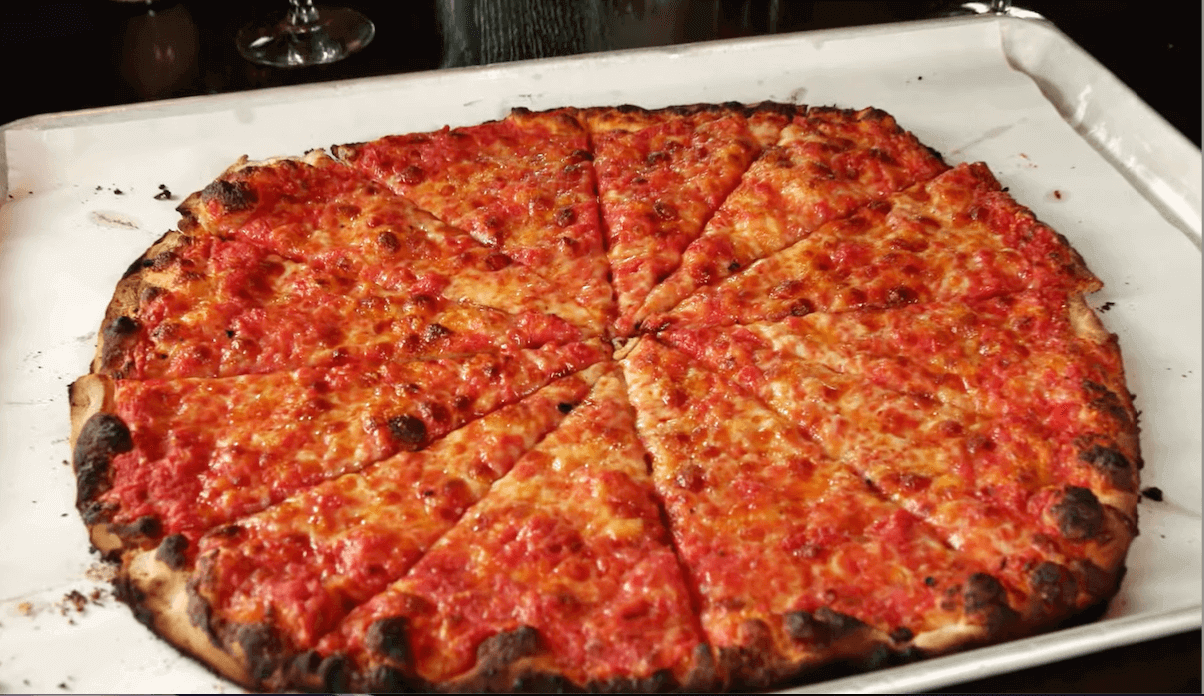
Next up is the bar pie. So what exactly is a bar pie, and why is it called that? A bar pie is essentially a super-thin, crispy version of a New York–style pizza—but with an even crunchier undercarriage and a distinct brown, lacy, cracker-like edge. Think of a well-done NY slice, but thinner, crispier, and built for snacking with a cold beer.
I’ll admit, I wasn’t very familiar with bar pies until I started watching Portnoy’s reviews. But Dave was right: after trying a few, bar pies quickly became one of my favorite styles.
Where do you find them? The name gives it away: in bars.
Some of these spots are neighborhood institutions that have been around for over a century, complete with their original ovens and old-school décor. Others are newer restaurants jumping onto the growing bar-pie trend.
Living in New Jersey, I’m lucky—there are fantastic bar pies everywhere. One of my local favorites is Nancy’s Townhouse in Rahway, still rocking that unchanged 50-year-old interior and turning out perfectly crisp pies. Up north, in my old stomping grounds, Kinchley’s Tavern in Ramsey serves a classic bar pie in a wood-paneled, time-capsule bar setting.
Portnoy’s reviews also led me to great pies at Angeloni’s in Caldwell and the iconic Star Tavern in Orange. And there are plenty more on my list. The truth is, bar pies have become one of my personal go-to styles—and Dave’s as well.
As for their origins, bar pies are unmistakably an East Coast creation, rooted in the taverns of New Jersey, and New York But as the style grows in popularity, you can now find bar pies in bars and pizzerias all across the country.
NY Style
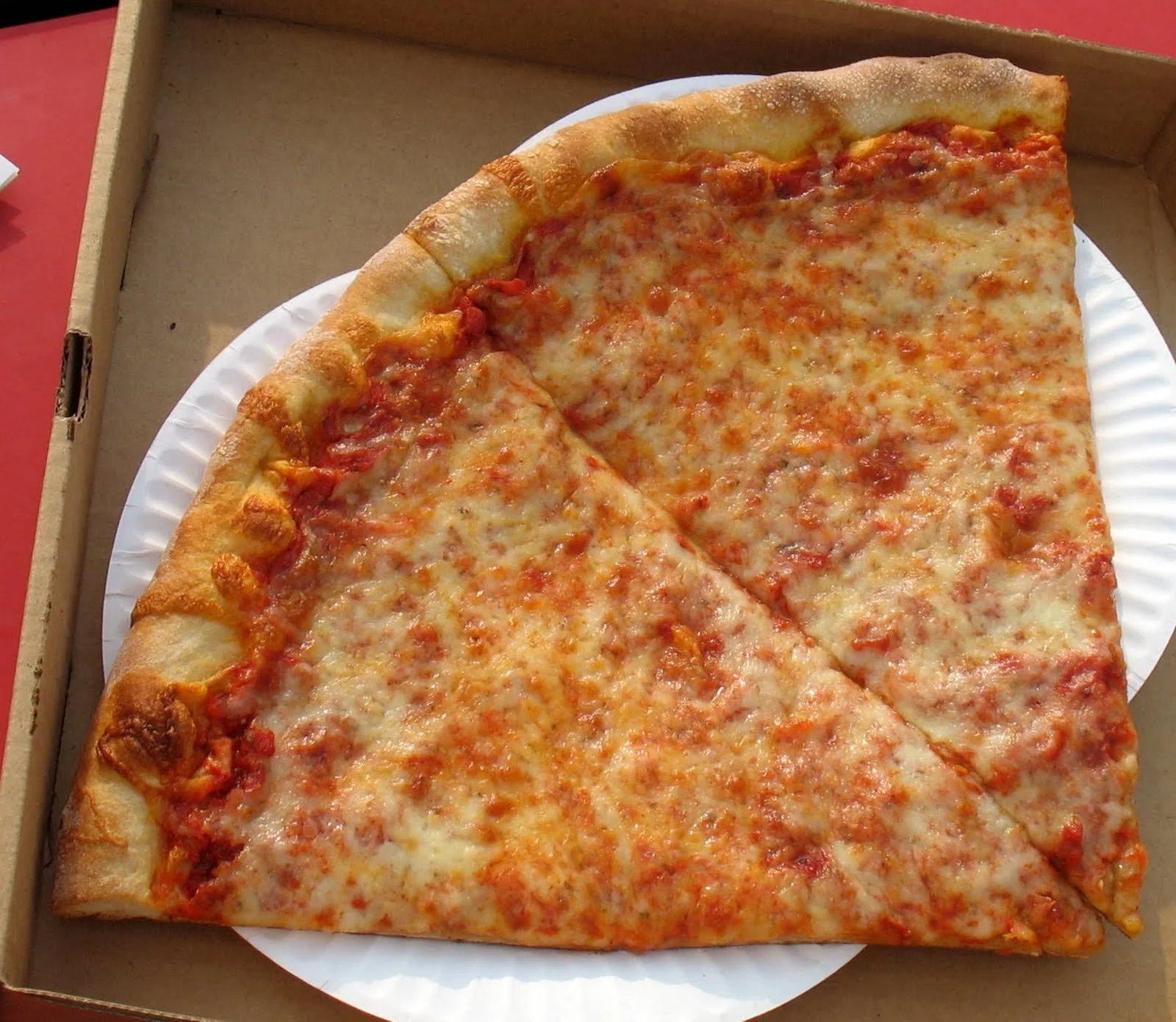
The next style is arguably the most iconic and widely recognized of them all: the New York–style pizza. While still technically a thin-crust pie, a NY slice has a slightly thicker, chewier dough than a bar pie or New Haven apizza. A classic New York pizza typically measures 18 to 20 inches in diameter, cut into large, triangular slices that fold perfectly in half.
Naturally, the style originates from the epicenter of pizza culture: New York City. The city is packed with pizzerias serving classic NY slices, from corner shops to century-old institutions. You can’t talk about New York–style pizza without mentioning Ray’s, the original West Village pizzeria that spawned countless imitators, all insisting they were the “original” or “famous” Ray’s too.
Other legendary New York names include John’s of Bleecker Street, Patsy’s, Di Fara, and Lucali. I’ve visited John’s, Patsy’s, and Di Fara—Di Fara being my personal favorite of the three, and also the recipient of an incredible 9.4 from Portnoy. Lucali remains firmly on my must-try list.
When it comes to the geography of NY-style pizza, its epicenter is the tri-state area, but the style has spread far beyond. Today, you can find a New York–style pie in virtually every major city in the country, and often more than one.
Tavern Pie
The next stop on this pizza tour is a style I didn’t even know existed until Dave Portnoy introduced it to me: the Tavern-style pie. While most people associate Chicago with deep-dish pizza, the truth is that tavern-style is actually far more common throughout the city and its suburbs.
Tavern-style pizza is a thin, cracker-like crust pie, baked to a crisp and designed for sharing. What makes it truly unique is the way it’s cut: into small squares, often called a tavern cut or party cut, perfect for passing around at a neighborhood bar—which is exactly how the style got its name.
Another quirky feature? The pizza box. Instead of opening from the top like a typical box, many tavern-style pizzas come in a side-opening, folded box. After watching countless Portnoy videos, I can confirm it’s definitely a bit awkward—and not exactly ideal for the “one bite, everybody knows the rules” moment.
In terms of geography, tavern-style pizza may have originated in Chicago, but it has spread throughout the Midwest, especially in cities like Milwaukee and St. Louis. I haven’t had the chance to try a true Midwestern tavern-style pie yet, but it’s definitely high on my list.

Deep Dish
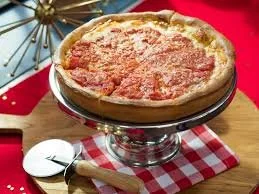
The next style is the one most people associate with Chicago, though it isn’t nearly as common there as I once assumed: deep-dish pizza. Created in the 1940s, deep dish was developed as a more substantial, meal-like alternative to traditional thin-crust pizza—so much so that many in the pizza world jokingly refer to it as a “casserole” rather than a pizza.
Deep dish is known for its high, buttery crust, often enhanced with cornmeal or semolina, forming a tall, pie-like edge. The style is widely credited to Pizzeria Uno, which went on to franchise throughout New Jersey and other states. Other iconic Chicago names include Lou Malnati’s and Giordano’s.
I’ve had Pizzeria Uno’s deep dish several times over the years, and I’ve tried Giordano’s through the mail-order service Goldbelly. While the epicenter of deep dish remains Chicago, the Uno franchise once helped spread the style beyond the Midwest. Over time, however, the number of Uno locations has declined, and as a result, deep-dish options in New Jersey today are pretty limited.
Detroit Pie
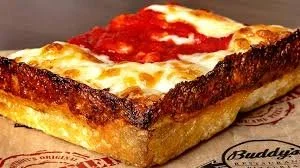
The next style is another city-named classic: the Detroit-style pizza. Detroit-style is a rectangular, pan-baked pie, but what truly sets it apart from every other style is its caramelized cheese edge. The way portnoy rates Detroit is by his moto, “that it looks heavy, but it’s light on its feet”. This signature feature comes from spreading the cheese all the way to the very edges of the pan so that it melts, crisps, and caramelizes against the steel, forming a crunchy, flavorful border.
Another defining element is the use of Wisconsin brick cheese, a semi-soft cheese similar to mozzarella but known for its exceptional melting and browning qualities. When baked, it helps create those distinctive crispy, lacy edges that Detroit-style pizza is famous for.
The style originated at Buddy’s Rendezvous (now just Buddy’s) in Detroit, which has since expanded into a regional chain. I actually visited Detroit this summer and tried the original at Buddy’s—and it lived up to the hype.
Detroit-style pizza has now spread far beyond Michigan. In fact, a great version is served right near me at O’Brian’s on the Green at the Hyatt Hills Golf Course, showing just how widely the style has caught on.
Roman Style
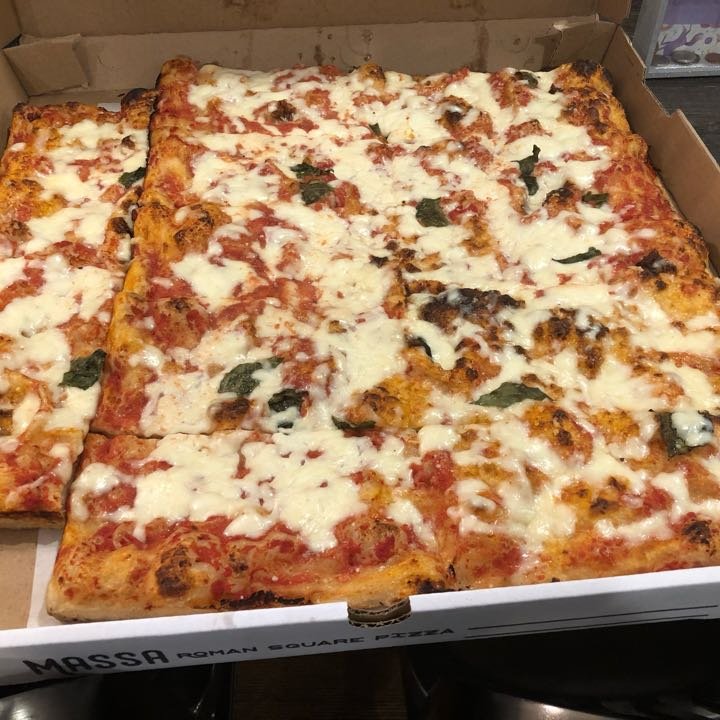
It makes perfect sense that one pizza style would be named after a city in Italy: the Roman-style pizza. Roman-style pizza is a rectangular, pan-baked pie made in large sheet pans and commonly sold as street food throughout Rome. What sets it apart is the way it’s sold by weight rather than by the slice—you point to the piece you want, they cut it with scissors, weigh it, and that determines the price.
Roman-style pizza is known for being light, airy, and crispy, with a delicate but flavorful dough. My go-to spot for this style is Massa’s in Scotch Plains, which offers unique varieties like pesto, potato and squash, and pancetta with black pepper—all sold individually. Every time I’m in Scotch Plains, I try to stop by Massa’s, whether I’m grabbing a slice to eat on the spot or bringing a few home.
Greek Style
Greek-style pizza is a regional specialty most closely associated with New England, though it has also become a staple in many college towns—often serving as the go-to late-night “drunk pizza.” Unlike bar pies or thin-crust slices, Greek pizza is closer to a pan pizza, typically baked in heavily oiled round pans that give it a soft, bready interior and a lightly fried, crisp bottom.
What truly sets Greek pizza apart, however, is its distinctive flavor—a sweet, oregano-forward sauce and a generous layer of cheese that often stretches nearly to the very edge of the pan. The result is a pie that’s hearty, aromatic, and unmistakably different from other regional styles.
In my travels through New England and various college towns, I’ve tried a number of Greek-style pies. While I respect its history and its loyal following, I’ll be honest: it’s not one of my personal favorites
Trenton Tomato Pie
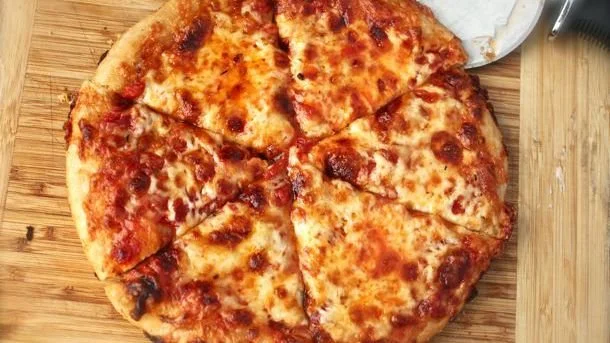
As a New Jersey resident who originally grew up in New York City, I have to acknowledge one of the state’s most iconic and uniquely regional styles: the Trenton tomato pie. This classic Mercer County creation flips the traditional pizza layering—cheese and toppings go on first, and the crushed tomatoes are spooned on top, giving the pie its signature look and flavor.
The style originates from Trenton and the greater Mercer County area, where two legendary pizzerias define the tradition: Papa’s Tomato Pies and De Lorenzo’s Tomato Pies. I’ve made the trip down to the Trenton area to try De Lorenzo’s, and I can say without hesitation that it’s a uniquely New Jersey experience—distinct, delicious, and unlike any other regional pizza style in the country.
Mustard Pie
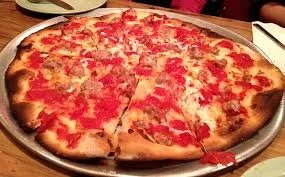
So after covering the Trenton tomato pie, we have to highlight one of the most unique pizzas in the entire country—a style found right within the heart of tomato pie territory: the New Jersey mustard pie. You could call it a variation of the Trenton tomato pie, but its one unexpected ingredient sets it apart.
So what exactly is a mustard pie? As the name suggests, it includes a thin layer of spicy brown mustard spread directly on the dough before the cheese, toppings, and tomatoes are added. That subtle layer of mustard transforms the flavor, giving the pie a tangy, savory kick you won’t find anywhere else.
The birthplace and undisputed home of the mustard pie is Papa’s Tomato Pies, one of the original Trenton tomato pie institutions. I haven’t made it there yet, but it’s high on my list—and I fully intend to try this uniquely New Jersey specialty in the near future.
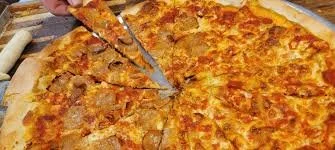
NJ Boardwalk Pizza
Since I’m a New Jersey transplant—yes, I grew up in NYC but eventually crossed the Hudson to call the Garden State home (thanks to the abundance of land use planning jobs)—I have to mention another uniquely local style: boardwalk pizza.
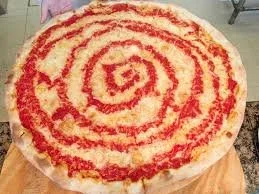
New Jersey is famous for its boardwalks—Wildwood, Point Pleasant, Ocean City—and with them comes a very specific kind of pizza. Boardwalk pizza is known for its giant, often overpriced, floppy slices, usually topped with a signature swirl of sauce on top. It’s a style designed for summer crowds, late-night bites, and walking along the boards with a slice in hand.
I’ve had plenty of boardwalk pizza over the years—from my younger days hanging out in Point Pleasant to family trips down to Wildwood and Ocean City. It may not be the most refined style, but it’s undeniably part of the Jersey Shore experience.
Altoona Pizza
Altoona pizza comes straight from western Pennsylvania near the Allegheny Mountains—an area I actually visited for a wedding. It’s one of the most unusual regional pizza styles in the country, and for one very specific reason: it uses yellow American cheese as the topping. Yes, yellow American.
Altoona-style pizza features a thick, almost Sicilian-like base,, and then a full slice of American cheese melted over each square, with tomato sauce on the bottom. The result is something that feels part pizza, part upside-down grilled cheese—and completely unique.
The style originated at the Altoona Hotel, but today you’ll find it served at several pizzerias throughout the region. It’s a true western Pennsylvania specialty and one of the most distinctive pies in the U.S.

Drunk Pizza
Every college town has that late-night pizza spot—the place you stumble into after a night of drinking, when hunger suddenly hits and you need something to soak up the alcohol. That’s the essence of drunk pizza.
What defines a drunk-pizza joint? It’s usually located right near the strip of bars, selling slices in every style imaginable. All the pies are pre-made and on display, staring back at you through the glass until you pick one out to be reheated in the oven. Convenience is the priority; quality is… negotiable.
The funny thing about drunk pizza is that it’s phenomenal when you’re drunk, and mediocre to downright bad when you’re sober. The magic disappears with the hangover.
I had my fair share of drunk pizza while in college at the University at Buffalo, frequenting local staples like Sal’s and Pinizzone’s—classic examples of the late-night slice that tastes amazing only at 2 a.m.

Conveyor belt pizza
The final pizza style on this list is, unfortunately, the worst. And yes—this list goes from best to worst, so we’re ending at the bottom: the conveyor-belt pizza.
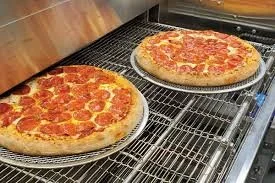
As the name suggests, this style is made using a conveyor-belt oven, where the pizza moves through a temperature-controlled tunnel until it emerges fully cooked. The process is efficient, requires less labor, and produces a highly consistent product.
But what you gain in consistency, you lose in flavor. Conveyor-belt ovens rarely achieve the crisp undercarriage or well-developed crust that defines great pizza. The result is standard, predictable, and often lacking character.
The most recognizable example of this style is the giant of American pizza chains: Domino’s—the undisputed king of conveyor-belt pies
The story of pizza in the United States is a uniquely rich and diverse one. Through the lens of Dave Portnoy’s reviews, I’ve discovered just how many regional styles exist across the country—each with its own history, flavor, and devoted following. Along the way, I’ve tried many of these styles myself, with plenty more still on my list.
Now that I’ve finished writing this “geography of pizza,” there’s only one thing left to do: eat some pizza.